Arguably the most famous ocean
liner, the Titanic and her story are
lodged in humanity’s collective consciousness.
The story of the sinking has been retold numerous times in print and in
film and the basic outline of events is well known. Rather than recap those events, lets consider
why people continue to be interested in this ship and bust a few myths while we’re at it.
What is the enduring fascination with Titanic?
 |
| 1:1250 Model of Titanic by Carlo Marquardt. Dockside accessories by Tri-Ang Minic and Mountford. |
I became aware of the Titanic
when the wreck was found. I was in
elementary school at the time and everything about the Titanic grabbed my boyhood imagination. There is a certain allure of a shipwreck—is
it the promise of finding treasure? Maybe
it is the action of seeing something hidden for years or a morbid trip to an
undersea grave. Or perhaps the curiosity
of something out of place, after all ships are meant to be pretty on top of the
waves, not wrecked below them. Whatever
it is, shipwrecks stir the imagination. It
in fact it is the wreck of Titanic
that endures. Had she met with
commercial success rather than tragic loss, she would not have the same place
in popular history. That is not to say
she would be forgotten—just remembered differently—known perhaps only to liner
historians or happy memories from countless travelers.
 |
| 1:1250 model and reproduction ephemera. |
Historical Perspective
Let’s put Titanic in perspective. When she entered service she
was “the largest ship in the world” by a small margin over her sister ship, Olympic.
The two ships were same dimensions, but some modifications to the Titanic’s accommodations made her
heavier. It was measurement of gross tonnage (which was, in fact, a calculation
of enclosed space) that made her larger than her sister. Even if she did not sink, the title would be
short lived. Cunard’s Aquitania and HAPAG’s Imperator, launched in 1912, readily outsized
Olympic and Titanic. All of these ships
sported amenities that tried to one-up the competition: swimming pools, gymnasiums, Turkish Baths, luxurious
suites, and exclusive restaurants.
 |
| Titanic passing Oceanic as she departs Southampton. |
Each ship in the series was an effort to out-do both their
fleet mates and the competition. Titanic’s improvements included a
stretch of glass enclosed promenade deck (Olympic’s
tended to get wet) and luxury suites with private promenades. The third ship, Britannic, was expected to incorporate even more refinements. She too, never fulfilled her potential and was
lost during WWI. White Star’s trio was a good gamble but
failed, not because of mismanagement or bad design, but of unforeseen
circumstances.
Poorly Built?
Some people claimed that the Titanic sank because it was poorly built and of faulty design. Blame is placed on supposedly inferior rivets
or weak steel. One TV documentary set
out to see if she had a “fatal flaw.” Reconstructed rivets, steel samples from
the wreck, or computer simulations are unnecessary to prove that there was no
fatal flaw. It is a testament to the
sound design and construction of these ships that Olympic sailed into the 1930s and scrappers cut into a sound
hull. Other Harland and Wolff built
ships of the same vintage sailed much longer, HAPAG’s Amerika (1905) for example.
This ship endured two world wars, a major fire, layups, and several
decades of passenger service. She was scrapped in 1957—that is 52 years
afloat. Would weak steel or shoddy
workmanship last that long? Perhaps the
sinking and disaster was so unthinkable that there must have been a technical
problem. True, the ship broke into
pieces; but only because the hull was subjected to stresses it was never
designed to cope with. No ship is meant
to lift out of the water without support.
 |
| Loading provisions. |
It is more appropriate to consider just how sturdy a ship she was. Olympic was considered a “good sea boat” and generally a steady ship. Titanic exhibited the same qualities (and calm seas) during the voyage. The iceberg’s wound caused slow flooding over a large area. She flooded symmetrically, on an even keel. This even-keel sinking is very unusual, as sinking ships tend to list severely and roll before going under. That was how other famous liners went down: Lusitania, Empress of Ireland, Andrea Doria—to name a few. Titanic’s design, as much as the nature of the wound kept her upright and kept her engine spaces dry.
 |
| Titanic's 20 lifeboats exceeded the legally required number. Detail of author's model under construction. |
The Titanic saved
lives. Had she flooded asymmetrically,
she likely would have rolled over and sank quickly. There would have been less time for people
find their way to the boat deck and to send distress calls. Loss of power meant a darkened ship. Fewer
lifeboats—that precious commodity—would have been launched. More people would have drowned or suffered
hypothermia. As it was, she kept people
safe and warm as long as possible.
 |
| The scale of things. 1:350 worker, wing screw, and lifeboats. |
Fascination and
Fiction
In the months following the disaster, survivors published
their narratives of the disaster. Images
flickered in newsreels and newspapers published photographs of the ship and the
people. The disaster receded from news media and was superseded by the Great War. Titanic
was not forgotten, just re-filed in the memory banks. The most enduring (and in many devotee’s
opinion) retelling of the disaster is Walter Lord’s A Night to Remember. This telling is as much about the insecurities
post war world of the 1950s than it is about Titanic in 1912. The movie Titanic
(1953) and adaptation of A Night to Remember (1958) highlight both the heroics and vanities of people, the sacrifice, and the importance
of families. There is much nostalgia for
a simpler time before nuclear weapons and the prospect of apocalypse, the rise
and fall of dictatorships, and the carnage and destruction of two world wars.
 |
| Titanic's triple screw arrangement was an uncommon arrangement. Most liners had one, two, or four screws. |
James Cameron’s 1997 blockbuster was a technological tour-de-force
(indeed making the 50s movies look
cheesy) but for as many viewers taken in by fictional romance there were others
turned off by it (and for all the stress on historical accuracy in the film,
these fictional characters are the greatest faux pas). The film did as much to bring the ship and
the story in the public eye, as did the discovery of the wreck in 1985. Indeed over the years since the wreck was located, many fine books were published about virtually every aspect of the ship.
 |
| A few of my Titanic books. |
In the midst of the cinematic resurrection, salvers were
raising artifacts from the wreck site. The
ethics of recovering plates, doorknobs, suitcases, even a piece of Titanic’s hull has been hotly
contested. Some argue that the wreckage
is a grave—a memorial—to the 1,500 lost and should be treated as such and left in peace. This point of view has morality and sentiment
on its side. Supporters of salvage argue that
recovering artifacts is preserving history. The items
are carefully conserved and exhibited on public exhibition and provide a window
into the past. As a historian I can well say that 1912 is not
a mysterious past (unlike say, ancient Egypt or the Stone Age). There are photographs, film footage, sound
recordings, letters, and countless objects that document the period. Though few survive today, there are people who
remember 1912. We do not need pieces of Titanic to learn about 1912. In fact, many of Olympic’s analogous pieces (dishes, doorknobs, woodwork) survive
today.

Memorials. Monuments.
Miniatures.
Are the models people build a kind monument? It is safe to say that the most often-modeled
ocean liner is Titanic. Plastic kits (and some card and wood kits)
are consistently available in range of scales and have been so since the
1970s. Few other liners are available in
kit form and mostly in small scales (1:1200, 1:600). But it is not dearth of choices that prompt
modelers to build replica Titanics but
desire. This author ranks among those
who chose, off and on, over the years to build these kits. As a youngster, I recall being drawn to the
hype of the large ship. Of course I wanted to build the biggest ship! As an adult, I am drawn to the ship for its
aesthetics and technical intricacy of the vessel.
 |
| 1:350 Minicraft Model kit hull and General Arrangement Plans by Bruce Beveridge, TRMA. |
Ships like Mauretania or
Queen Mary had happy voyages and
embody the spirit of ocean travel. As
followers of this blog will see, that is what calls to me. I collect these small models and build kits
(and attempt scratch builds off and on) because there is beauty in them. Those little waterline models seem at motion
across the shelf. Pair them with a
photograph of the original or a souvenir and they come to life. I admit the nostalgia for a period in time—for
an experience—I cannot recall first hand.
 |
| Titanic at sea. |
The Titanic does
not evoke the happy crossing or a lost age of travel, but tragedy. While I admire their work and I mean no
disrespect to those who create models of the sinking ship or Titanic’s wreckage, I do wonder, why build such a model? I can understand such a creation
as a museum exhibit—to educate people about the power of the sea, the ravages
of time, or how nature recycles materials. Are these memorials? Or are these evoking the mystery of a shipwreck? Is it a chance to visit a place few can visit, let alone stand back and see the big picture? Photographs of the wreckage and
debris on the ocean floor are powerful reminders of the tragedy and the
fragility of both man and machine. Can a miniature convey the same message? Such projects, while fascinating, also seem macabre to me.
 |
| The author's Minicraft 1:350 model 90% complete. |
For me, making or collecting these miniature ships allows me
to see up close something I otherwise cannot.
When I build a diorama or glue miniature figures to the decks I realize
the power of making a world. Those
things are static but very much moving in my mind. I suspect it is much the same to model
railroaders overseeing their rights of way.
The railway is their little world, ordered and operating to their whims.
They reenact and celebrate the running of trains. I think for many of us, that is why we model
these liners. We want to see them sail
the waves again. Perhaps with Titanic, modelers really want to change
the outcome of that first crossing. They
want the power to change course and see her arrive, possibly late, probably dented, but safe in the Hudson River.
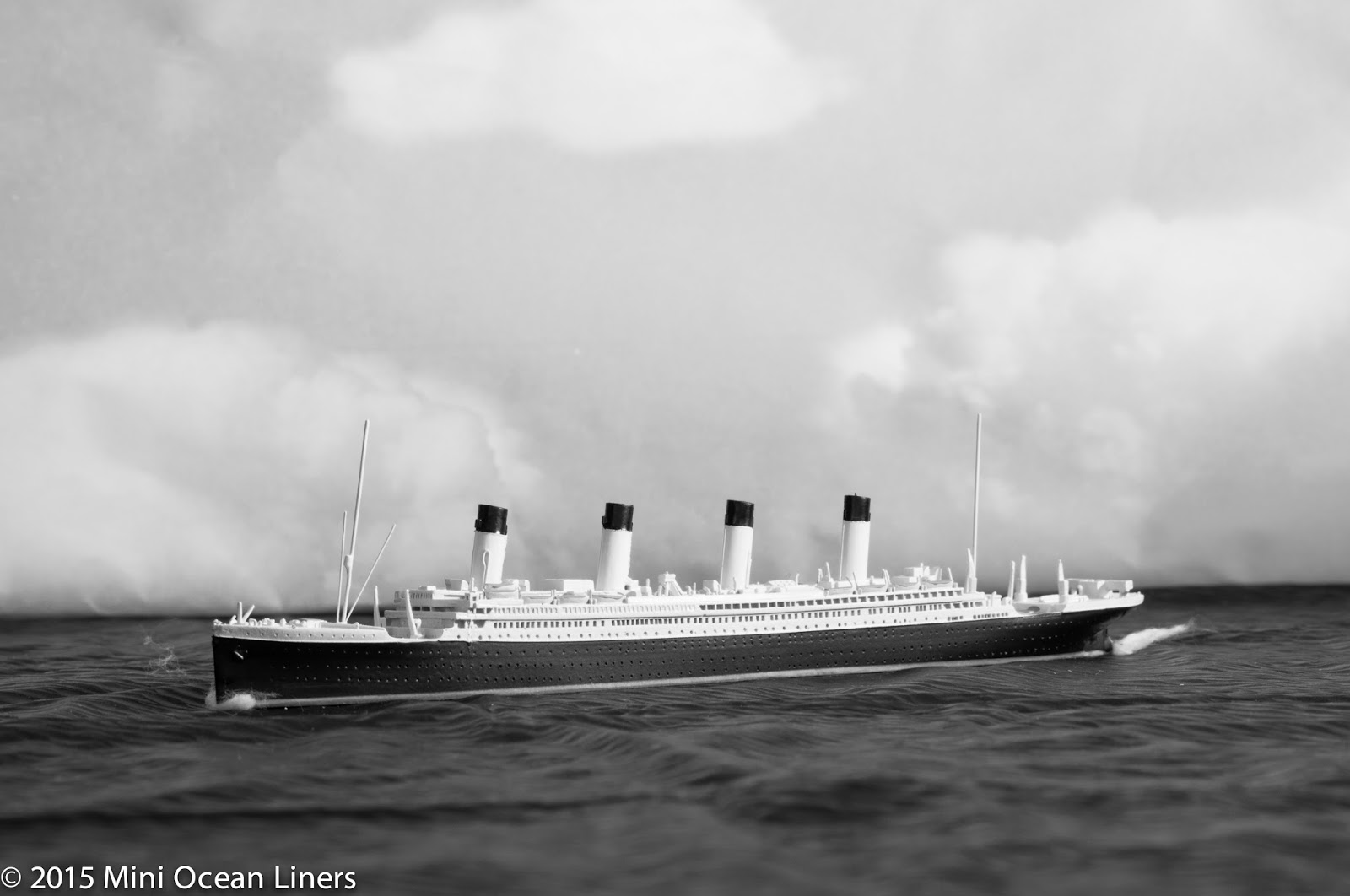 |
| R.M.S Titanic (1912) Built for White Star Line by Harland & Wolff, Ltd. Belfast, Northern Ireland. 46,329 GRT; 882.5 feet long, 92 feet wide. Steam triple expansion reciprocating engines, triple screw. Service speed 21 knots. 2,603 total passengers (905 First Class, 564 Second Class, 1,134 Third Class). |


